


What a difference a day makes.
Following Tuesday's midterm elections, markets initially rallied on Wednesday as investors welcomed the prospect of a divided government in Washington. By Thursday, however, that optimism had given way to a sharp selloff.
The S&P 500 fell approximately 4.4%, its worst single-day decline since the tariff-related market turmoil in April 2025. The technology-heavy Nasdaq Composite dropped 5.5%, pushing the index into correction territory, more than 10% below its recent high. Nvidia, one of the biggest beneficiaries of the artificial intelligence boom, declined approximately 9%. (CNBC)
So, what changed in just 24 hours?
In our view, investors are weighing two somewhat competing developments. Divided governments may reduce the likelihood of sweeping changes to federal policy, which has historically been favorable for markets. At the same time, the election raises new questions about the outlook for several important sectors, particularly technology and artificial intelligence.
Let's take a closer look at what happened, what we're watching, and what it could mean for investors going forward.
Why a Divided Government Can Be Good for Markets
With Democrats winning control of both chambers of Congress and President Trump remaining in the White House, Washington is headed toward divided government beginning in January. Historically, this arrangement has often treated investors favorably, primarily because it makes enacting major legislative changes more difficult.
Congress can propose and pass legislation, but the president generally must sign it into law. A presidential veto can be overridden, but doing so requires substantial bipartisan support. In practice, this means neither political party is likely to advance its entire agenda without significant compromise.
While legislative gridlock can certainly be frustrating, it also creates a degree of predictability. Businesses and investors may have greater confidence in their planning when the likelihood of sudden, sweeping policy changes is reduced. Of course, divided governments don’t eliminate political uncertainty. Executive actions, regulatory decisions, and foreign policy can still influence markets, and disagreements over federal spending and budgeting remain potential sources of volatility. Nevertheless, we generally view the prospect of a more constrained legislative environment as a positive development for long-term investors.
Why Did Markets Sell Off?
If investors initially welcomed divided government, why did stocks experience such significant losses the following day?
Much of the answer appears to be concentrated in the technology sector, particularly companies tied to artificial intelligence and data-center development. Over the past several years, technology companies have invested enormous sums into AI infrastructure. These investments have helped support earnings expectations and stock valuations throughout the sector.
The election results have introduced new questions about how quickly this expansion can continue.
Democratic lawmakers and newly elected state officials may pursue greater oversight of AI development, including the construction of new data centers. Concerns about electricity consumption, water resources, local infrastructure, and the broader economic consequences of AI expansion have also received increasing attention. Take our home state of Texas for example: down on the coast, Corpus Christi is projected to be the first state in the Union to reach “Day Zero” – the point where a city or region's water supply reaches critically low levels… six months away from demand exceeding supply (CBSNews).
Importantly, some decisions on AI, water-usage, etc. will occur at the state and local levels, where divided federal government may offer little protection against use of additional restrictions.
For investors, the concern isn't necessarily that AI development will stop. Rather, it's that a slower or more expensive buildout could affect future revenue growth and profitability, particularly for companies whose valuations assume substantial continued spending.
Thursday's selloff also reflected concerns that existed well before the election, including elevated technology valuations, significant capital expenditures, and questions about when AI-related investments will deliver meaningful returns.
Why This Matters for the Broader Market
It's easy to assume that weakness in the technology sector would primarily affect investors with significant holdings in companies like Nvidia, Microsoft, or Apple. Unfortunately, the impact can extend much further.
As of October 30, 2026, technology companies represented 37.4% of the S&P 500's total market capitalization (S&P Global). Furthermore, that figure doesn’t include several other technology-adjacent companies, such as Alphabet and Meta, both of which are classified in the communications services sector.
The S&P 500 is a market-capitalization-weighted index, meaning larger companies have a greater influence on its performance than smaller ones. As a result, significant losses among a relatively small group of technology companies can have an outsized impact on the broader index.
This concentration is particularly important for investors holding S&P 500 index funds or other market-cap-weighted investments. These funds may provide exposure to hundreds of companies, but that doesn't necessarily mean their investments are equally distributed across different sectors. Even investors whose portfolios have more modest allocations to technology can feel the effects when weakness in the sector contributes to broader market declines. That said, this is one reason we've continued emphasizing diversification beyond the largest technology companies, particularly into other sectors, investment styles, and asset classes.
Three Areas We’re Watching
1. Technology and Financial Services
We expect technology and financial services to remain sensitive to political developments over the coming months. For technology companies, the primary questions involve AI regulation, data-center development, capital spending, and whether future earnings can justify current valuations. Financial companies may face additional scrutiny of banking practices, consumer protection, and other regulatory issues.
In both sectors, uncertainty surrounding possible policy changes could create additional volatility even if relatively little new legislation ultimately becomes law. We don't believe these developments necessarily justify abandoning either sector. However, they do reinforce the importance of understanding how much of a portfolio's performance depends on a relatively small group of companies or industries.
2. Fiscal Policy, Interest Rates, and Bonds
Divided governments may also have implications for the broader economy and fixed-income markets. With major new spending initiatives potentially facing greater resistance in Congress, the likelihood of substantial additional fiscal stimulus could diminish.
Less government stimulus could contribute to slower economic growth, all else being equal. In turn, that could place downward pressure on Treasury yields. For bond investors, declining yields generally mean rising prices for existing fixed-rate bonds, potentially creating a more favorable environment for portions of the fixed-income market.
However, this is far from guaranteed. Inflation, federal borrowing needs, economic growth, and Federal Reserve policy will continue to influence interest rates. We view this as a potential opportunity rather than a prediction that rates will necessarily decline.
3. Continued Volatility
We wouldn't be surprised to see elevated volatility continue through the end of the year and into early 2027.
The newly elected Congress won't take office until January, and investors will be watching closely to see how aggressively lawmakers pursue their policy priorities once they do. There may be periods when markets react strongly to proposed legislation, regulatory announcements, or political disagreements, even if those developments ultimately have little lasting impact.
Over time, however, we believe corporate earnings, economic growth, interest rates, and valuations will matter considerably more to long-term market performance than the day-to-day headlines coming out of Washington.
What History Tells Us About the Markets
While the immediate market reaction has been unsettling, historical performance offers some encouraging perspective. According to research published by J.P. Morgan, the S&P 500 has generated a positive return over the 12 months following every midterm election since 1950, averaging approximately 15%.
That's a remarkable historical record, particularly considering how different the political and economic environments have been across those elections.
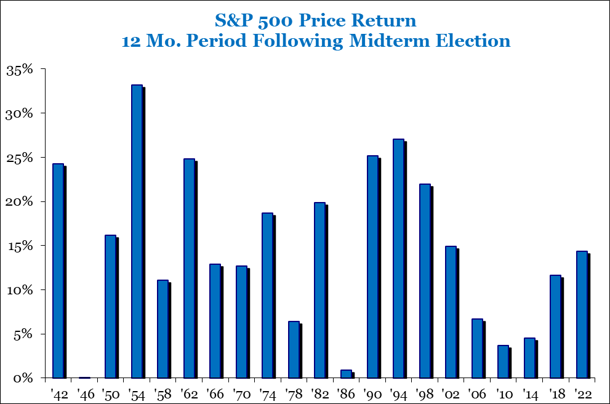
There are several possible explanations for this pattern.
First, elections remove a degree of uncertainty. Once investors know the likely political landscape for the next two years, businesses and markets can begin adjusting their expectations accordingly. Relatedly, the potential for legislative gridlock may reduce concerns about major policy shifts. Finally, markets are forward-looking. By the time an election takes place, investors may have already incorporated many anticipated outcomes into stock prices.
There is an important caveat, however: historical averages tell us very little about the path markets take to get there. Even years that ultimately produced positive returns experienced periods of significant volatility. A positive return 12 months after an election doesn't mean investors will have avoided losses along the way. Take the 1986 midterm for example, the market gained as much as 38% from November 1986 through the following August, only to give up nearly all its gain to finish approximately 4% positive in November 1987.
It's also worth remembering that these returns occurred under a wide range of economic circumstances. Interest rates, inflation, corporate earnings, and economic growth have all played important roles. We cannot attribute those historical gains solely to election outcomes. While the historical results are encouraging, past performance is never a guarantee of future results.
What Does This Mean for Your Portfolio?
or our clients, the election results don't fundamentally change our investment philosophy. We've generally maintained a more defensive approach in many of our portfolios, including meaningful allocations away from technology and other market-sensitive sectors.
We believe this positioning may have helped reduce exposure to some of the risks that have emerged this week, although it certainly doesn't make portfolios immune to broader market declines.
We also recognize that volatility can create opportunities. Sharp market movements can sometimes result in attractive valuations for investments with strong long-term fundamentals. However, we're not interested in attempting to predict the exact market bottom or making major portfolio changes based solely on a few days of trading.
Instead, we'll continue evaluating portfolio allocations, monitoring economic conditions, and looking for opportunities to rebalance where appropriate.
Diversification remains particularly important in an environment where a relatively small number of large technology companies can have an outsized influence on major market indexes.
That said, it doesn't mean avoiding technology companies altogether. Many of these companies remain important contributors to the economy and may continue to offer attractive long-term opportunities. Rather, it's about maintaining an appropriate balance between different investments so that a portfolio's success doesn't depend too heavily on any one sector, company, or economic outcome.
Looking Beyond 2028
One longer-term consideration worth keeping in mind is the potential impact of this election on future policy.
U.S. senators serve six-year terms, meaning those elected this week will remain in office beyond the next presidential election in 2028. Depending on the results of that election and the future makeup of Congress, proposals involving corporate taxation, regulation, government spending, and other major policy areas could become more politically viable.
For example, a future administration with greater congressional support might have more opportunities to pursue changes to corporate tax rates, higher-income tax brackets, or technology regulation. That's not something we would recommend positioning portfolios around today. Much can change between now and then, including economic conditions, legislative priorities, and control of Congress itself. Nevertheless, these are developments we'll continue monitoring as part of our ongoing investment research.
The Bottom Line
The midterm elections have created an interesting combination of near-term uncertainty and potentially favorable longer-term conditions for investors.
Divided government may constrain sweeping policy changes, but additional scrutiny of technology, artificial intelligence, and financial services could continue to influence markets over the coming months. Despite this week's volatility, history offers reasons for cautious optimism. More importantly, the fundamentals that ultimately drive investment returns haven't suddenly disappeared because of an election.
At Himelick Financial Group, our focus remains on maintaining diversified portfolios, evaluating opportunities as they arise, and helping our clients make informed decisions without allowing short-term headlines to dictate their long-term financial plans.
Political leadership will change over time. A disciplined investment strategy shouldn't need to change with every election.
If recent market developments have you wondering whether your investments are appropriately positioned, we're always happy to have a conversation about your portfolio and financial goals.
Asset allocation cannot eliminate the risk of fluctuating prices and uncertain returns. The return and principal value of bonds fluctuate with changes in market conditions. If bonds are not held to maturity, they may be worth more or less than their original value. A diversified portfolio does not assure a profit or protect against loss in a declining market. Investors cannot invest directly in indexes. The performance of any index is not indicative of the performance of any investment and does not take into account the effects of inflation and the fees and expenses associated with investing. All investing involves risk, including the possible loss of principal. There is no assurance that any investment strategy will be successful. The views stated in this letter are not necessarily the opinion of Cetera Wealth Services, LLC and should not be construed directly or indirectly as an offer to buy or sell any securities mentioned herein. Due to volatility within the markets mentioned, opinions are subject to change without notice. Information is based on sources believed to be reliable; however, their accuracy or completeness cannot be guaranteed. Past performance does not guarantee future results. Investors should consider their financial ability to continue to purchase through periods of low price levels. Past performance is not an indication or guarantee of future results. All information is believed to be from reliable sources. However, we make no representation as to its completeness or accuracy. Please keep your original official statement(s) in a safe, secure location. S&P 500 – A capitalization-weighted index of 500 stocks designed to measure performance of the broad domestic economy through changes in the aggregate market value of 500 stocks representing all major industries.